

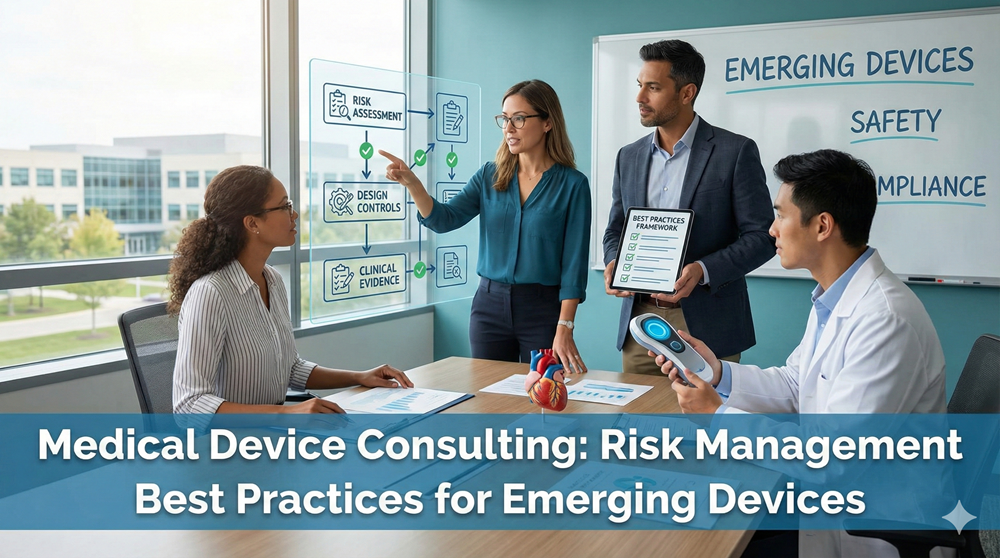
Emerging medical devices are reshaping healthcare by improving diagnostics, treatment accuracy, and patient outcomes. However, innovation also introduces uncertainty, regulatory scrutiny, and safety challenges that must be addressed early. Effective risk management is essential for developers seeking to bring new devices to market efficiently while protecting patients and maintaining compliance. Many organizations align medical device risk strategies with broader regulatory disciplines such as pharmaceutical consulting to ensure consistency and quality across development programs.
Risk management is not a one-time task. It is an ongoing, structured process that spans the entire device lifecycle—from concept and design through post-market surveillance. Below are best practices that medical device consulting teams recommend for managing risk in emerging technologies.
Understanding Risk Management in Medical Device Development
Risk management in medical devices focuses on identifying hazards, estimating and evaluating associated risks, controlling those risks, and monitoring the effectiveness of controls over time. International standards such as ISO 14971 provide the foundation for this process and are widely recognized by regulatory authorities.
For emerging devices, risks may be less predictable due to novel materials, software-driven functionality, or new clinical applications. This makes a proactive, methodical approach even more critical.
Start Risk Management Early in the Design Phase
One of the most effective risk management strategies is to begin as early as possible. Early-stage risk identification allows design teams to eliminate or reduce hazards before they become embedded in the product architecture.
Key Early-Stage Activities
- Conduct preliminary hazard analyses during concept development
- Identify foreseeable misuse and user-related risks
- Evaluate new technologies or materials for unknown failure modes
By integrating risk considerations into design inputs, teams can make informed decisions that reduce downstream rework and regulatory delays.
Apply a Structured Risk Analysis Framework
A consistent framework ensures that risks are evaluated objectively and documented clearly. Common tools include Failure Modes and Effects Analysis (FMEA), Fault Tree Analysis (FTA), and hazard analysis matrices.
Best Practices for Risk Analysis
- Use standardized scoring criteria for severity and probability
- Document assumptions and data sources
- Revisit analyses as the design evolves
For emerging devices, it is especially important to update risk analyses frequently, as new information becomes available through testing or clinical feedback.
Integrate Risk Controls into Design and Processes
Risk control measures should follow a logical hierarchy, prioritizing design solutions over warnings or user training. Built-in safety features are generally more reliable than procedural controls alone.
Types of Risk Controls
- Design modifications that eliminate hazards
- Protective measures such as alarms or interlocks
- Clear labeling and instructions for use
Each control should be verified and validated to confirm it effectively reduces risk without introducing new hazards.
Address Software and Cybersecurity Risks
Many emerging medical devices rely heavily on software, connectivity, or artificial intelligence. These technologies introduce unique risks related to data integrity, cybersecurity, and system reliability.
Managing Digital Risks
- Perform software-specific risk assessments
- Address cybersecurity threats as patient safety issues
- Plan for software updates and lifecycle maintenance
Regulatory expectations increasingly emphasize secure and reliable software performance, making this a critical focus area.
Incorporate Human Factors and Usability Engineering
User interaction is a common source of device-related risk. Human factors engineering helps identify how real-world users may interact with a device in ways not originally intended.
Human Factors Best Practices
- Conduct usability testing with representative users
- Analyze use-related hazards and potential errors
- Refine design based on observed user behavior
For emerging devices, usability studies are particularly valuable because clinicians and patients may have limited prior experience with the technology.
Maintain Strong Documentation and Traceability
Clear documentation is essential for regulatory submissions and audits. Risk management files should demonstrate traceability between hazards, controls, verification activities, and residual risk evaluations.
Documentation Tips
- Keep risk management files up to date
- Align risk documentation with design history files
- Ensure consistency across technical and clinical records
Well-organized documentation not only supports compliance but also simplifies internal communication and decision-making.
Plan for Post-Market Risk Monitoring
Risk management does not end at product launch. Post-market surveillance provides real-world data that can reveal previously unidentified risks or confirm the effectiveness of existing controls.
Post-Market Activities
- Monitor complaints and adverse events
- Review clinical performance data
- Update risk assessments based on field feedback
A feedback-driven approach helps organizations continuously improve device safety and maintain regulatory confidence.
Conclusion
Risk management is a cornerstone of successful medical device innovation, especially for emerging technologies. By starting early, applying structured analyses, integrating robust controls, and maintaining vigilance after market entry, developers can reduce uncertainty and enhance patient safety. Medical device consulting expertise plays a vital role in guiding these efforts, helping organizations navigate complex requirements while bringing innovative solutions to healthcare responsibly and efficiently.