Introduction
Generative AI is transforming how businesses operate, automating content creation, customer support, decision-making, and more. But with this power comes responsibility. Every prompt, every model interaction, and every dataset used to train or fine-tune a GenAI system carries privacy and compliance implications.
For organizations adopting generative AI, the question is no longer whether to use it, but how to use it safely. This guide breaks down what data privacy means in the context of GenAI, the risks involved, key regulations to follow, and practical steps to build a compliant, privacy-first AI environment.
What Is Data Privacy in Generative AI?
Data privacy in generative AI refers to how personal, sensitive, or proprietary information is collected, processed, stored, and used across the AI lifecycle, from training data to user prompts to generated outputs.
Unlike traditional software, generative AI systems learn from large datasets and produce dynamic outputs. This creates unique privacy concerns: training data may contain personal information, prompts may expose confidential business data, and outputs may unintentionally reveal sensitive details.
Ensuring privacy means controlling what data goes in, how it’s used, and what comes out, without compromising the model’s value or performance.
Why Data Privacy and Compliance Matter for GenAI
Failing to manage privacy and compliance in generative AI can lead to:
- Heavy regulatory fines under GDPR, HIPAA, and similar laws
- Loss of customer trust and brand reputation
- Exposure of trade secrets and confidential business data
- Legal disputes over data ownership and consent
- Operational disruption from forced model retraining or shutdowns
For regulated industries like healthcare, finance, and government, even minor lapses can have major consequences. Building privacy and compliance into your GenAI strategy from day one is no longer optional, it’s essential.
Common Data Privacy Risks in Generative AI
Generative AI introduces a new class of risks that traditional IT systems don’t fully address:
- Training data leakage: Models can memorize and inadvertently reproduce sensitive data from their training set.
- Prompt-based exposure: Employees may paste confidential or personal data into prompts without realizing it ends up on third-party servers.
- Unintended output: AI-generated content can include private or copyrighted material learned during training.
- Shadow AI usage: Teams adopt unsanctioned AI tools without IT oversight, bypassing privacy controls.
- Third-party model risks: Public APIs may log, retain, or repurpose user data unless explicitly restricted.
- Hallucinations and misinformation: Inaccurate outputs about real individuals can violate privacy and data accuracy laws.
- Lack of audit trails: Without proper logging, it becomes impossible to demonstrate compliance.
Key Regulations Governing AI and Data Privacy
Generative AI doesn’t sit outside existing data protection laws, it’s directly governed by them. The most important regulations to understand include:
- GDPR (European Union): Strict rules around personal data, consent, the right to be forgotten, and automated decision-making.
- HIPAA (United States): Governs the use and disclosure of protected health information in healthcare settings.
- CCPA / CPRA (California): Provides consumer rights around personal data collection, sale, and deletion.
- EU AI Act: Classifies AI systems by risk level and imposes specific obligations on high-risk and general-purpose AI.
- PIPEDA (Canada), DPDP Act (India), PDPL (Saudi Arabia, UAE, Qatar): Region-specific data protection laws relevant for global businesses.
- Industry-specific frameworks: SOC 2, ISO 27001, PCI DSS for finance, NIST AI Risk Management Framework, and others.
Compliance often involves more than one regulation, especially for businesses operating across borders.
Best Practices for Ensuring Data Privacy
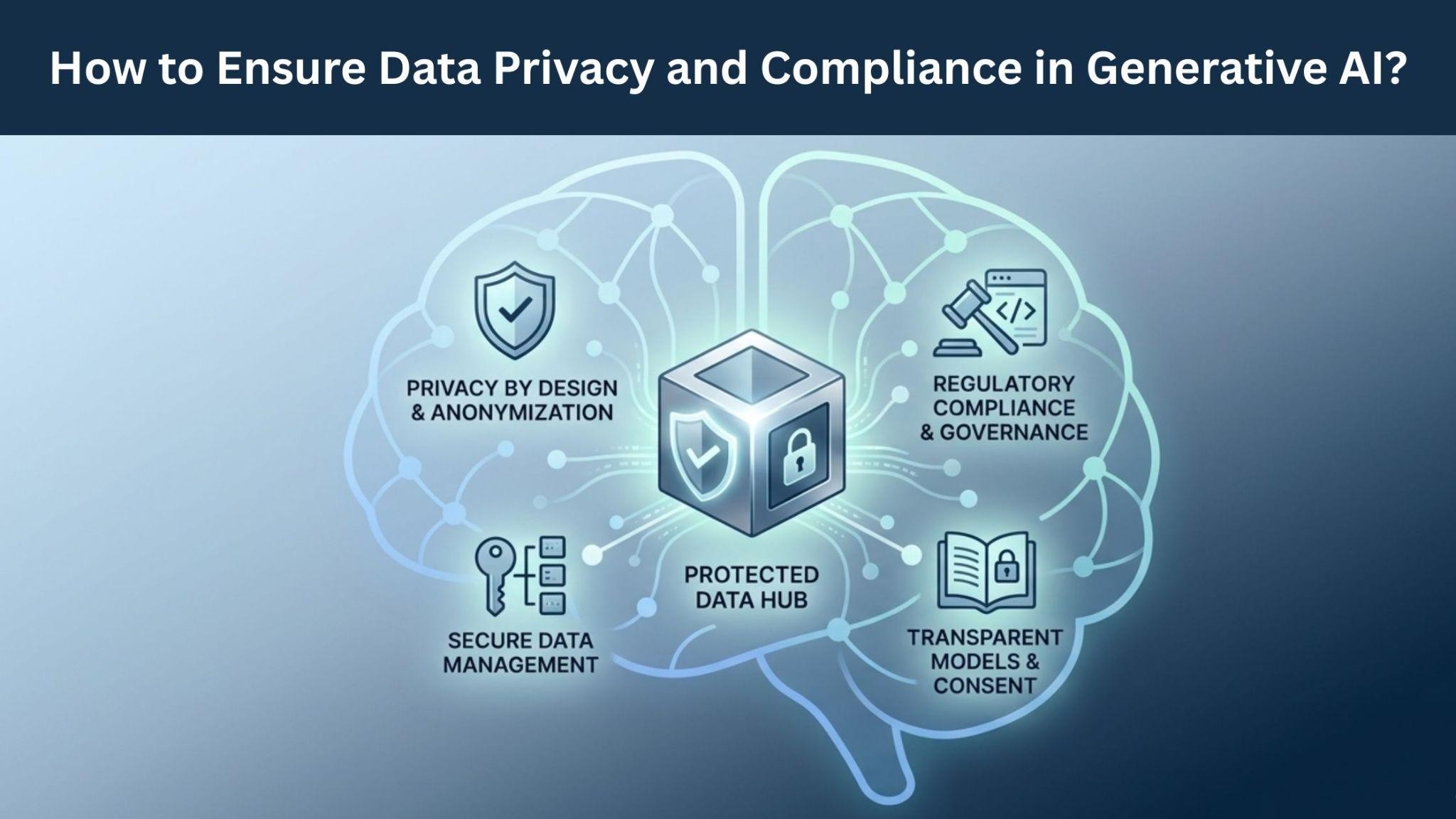
Strong data privacy in generative AI is built on a layered approach. Core best practices include:
- Data minimization: Use only the data that’s strictly necessary for the task.
- Anonymization and pseudonymization: Strip or mask personal identifiers before feeding data into models.
- Encryption: Protect data in transit and at rest with strong encryption standards.
- Access controls: Limit model and data access based on roles and least-privilege principles.
- Private deployments: Use on-premise, virtual private cloud, or dedicated tenant deployments for sensitive data.
- Prompt and output filtering: Deploy guardrails that detect and block sensitive data in prompts and responses.
- Data residency controls: Ensure data stays within approved geographic regions.
- Vendor due diligence: Choose AI providers with clear data usage, retention, and deletion policies.
Steps to Build a Compliance-Ready GenAI System
Building a privacy-first generative AI environment requires a structured approach:
- Map your data: Identify what personal, sensitive, or regulated data could touch your AI system.
- Define use cases and risk levels: Classify AI applications by risk and regulatory exposure.
- Choose the right deployment model: Public API, private cloud, hybrid, or on-premise based on sensitivity.
- Apply privacy by design: Build privacy controls into architecture, not as an afterthought.
- Implement robust logging and audit trails: Record prompts, outputs, and model decisions for compliance review.
- Train and educate teams: Set clear policies on what employees can and cannot share with GenAI tools.
- Run privacy impact assessments (DPIAs): Especially for high-risk use cases involving personal data.
- Continuously monitor and update: Regulations and AI capabilities evolve, your controls must too.
Role of AI Governance and Ethical AI
Privacy and compliance can’t be solved with technology alone, they require strong governance. AI governance includes:
- A clear AI usage policy across the organization
- An AI ethics or governance committee overseeing deployments
- Defined roles for data stewards, AI owners, and compliance officers
- Documented model lifecycle management and version control
- Bias, fairness, and explainability assessments
- Incident response plans for AI-related privacy breaches
Ethical AI goes beyond compliance, it ensures that GenAI systems are transparent, fair, and aligned with both legal and human values.
How to Choose a Compliant GenAI Development Partner
When selecting a generative AI development partner, look for:
- Demonstrated experience with regulated industries
- Strong data security certifications (ISO 27001, SOC 2, HIPAA-ready)
- Transparent data handling, retention, and deletion policies
- Support for private and on-premise deployments
- Clear AI governance and responsible AI practices
- Built-in safeguards: prompt filtering, audit logs, and access controls
- Willingness to sign DPAs, BAAs, and NDAs as needed
A trusted partner doesn’t just build models, they help you deploy AI responsibly.
Looking for a reliable generative AI development company that puts privacy and compliance first?
Companies like: Apptunix as well as Blocktunix helps enterprises, startups, and government organizations build secure, compliant, and production-ready GenAI solutions, from strategy to deployment.
Final Thoughts
Generative AI offers massive opportunities, but only for businesses willing to deploy it responsibly. Strong data privacy and compliance practices aren’t a barrier to AI adoption, they’re what makes adoption sustainable.
By understanding the risks, following key regulations, applying best practices, and choosing the right development partner, your organization can unlock the full power of generative AI without compromising trust, security, or compliance.
FAQs
1. Can I use ChatGPT or other public AI tools with sensitive business data?
Generally no, unless the provider offers an enterprise plan with strict data privacy guarantees, including no data retention or training on your inputs.
- Does GDPR apply to generative AI?
Yes. GDPR applies to any system that processes personal data of EU residents, including AI training, prompts, and outputs.
- What’s the safest way to deploy generative AI for healthcare or finance?
Use private or on-premise deployments with HIPAA-compliant or SOC 2-certified infrastructure, combined with strong data anonymization.
- How do I prevent employees from leaking data through AI tools?
Set clear policies, deploy approved AI tools, restrict access to public APIs, and use prompt monitoring or DLP solutions.
- Are AI-generated outputs considered personal data?
They can be, especially if they identify or relate to a real person. Outputs must be handled under the same privacy rules as input data.
- Should small businesses worry about AI compliance?
Yes. Privacy laws apply regardless of company size. When planning the cost to develop a generative AI app, factor in privacy safeguards from day one, it’s far cheaper than fixing breaches later.
Author Bio: Vinny is a passionate content writer with a strong interest in technology and digital trends, bringing over 5 years of experience in creating impactful content. Her work simplifies complex business concepts, delivering strategic insights that enable brands to drive growth and strengthen audience engagement. The content she develops is rooted in practical experience and reflects a strong understanding of evolving digital trends and market dynamics.