The phrase managed IT services has been in circulation for decades, but the service it describes in 2026 is fundamentally different from what it described in 2021. The five years separating those two moments have produced more change in how IT services are delivered, what they cover, and what they cost than the preceding decade combined. For Boca Raton businesses evaluating their current IT relationships or exploring managed services for the first time, understanding what has changed is the starting point for making decisions that reflect the current landscape rather than outdated assumptions.
From Helpdesk to Strategic Operations Partner
The managed IT services model that most businesses encountered five years ago was primarily a staffed helpdesk and remote monitoring function. Problems were logged, prioritized, and resolved. Systems were monitored for availability. Updates were applied on schedule. The value proposition was reliable support delivered more cost-effectively than a fully internal IT team.
That description still fits the entry-level tier of managed IT, but it describes a fraction of what the most capable managed IT providers are delivering in 2026. The shift has been driven by three converging forces: the expanded complexity of the IT environments that businesses are running, the elevated cybersecurity threat landscape that has made security an inseparable component of IT operations, and the AI-powered tooling that has transformed what proactive IT management can actually do.
The managed IT relationship that Boca Raton’s most operationally sophisticated businesses are building in 2026 is closer to a strategic technology operations partnership than to the helpdesk-plus-monitoring model that defined the category five years ago. The provider is not just keeping systems running. They are continuously optimizing the environment, managing the security posture, navigating compliance obligations, integrating new technology capabilities, and advising on the technology investments that will support the business’s next stage of growth.
AI-Native Monitoring Has Replaced Manual Processes
One of the most significant changes in the managed IT services landscape over the past five years is the replacement of manual monitoring and threshold-alerting processes with AI-native operational tools that provide genuinely predictive rather than reactive infrastructure management.
The monitoring infrastructure that characterized managed IT services in 2021 relied primarily on threshold alerts: a system resource exceeded a defined percentage, a service stopped responding, a backup job failed to complete. These alerts triggered human investigation and response. The model worked for obvious, acute failures but consistently missed the gradual degradation patterns that precede most significant outages.
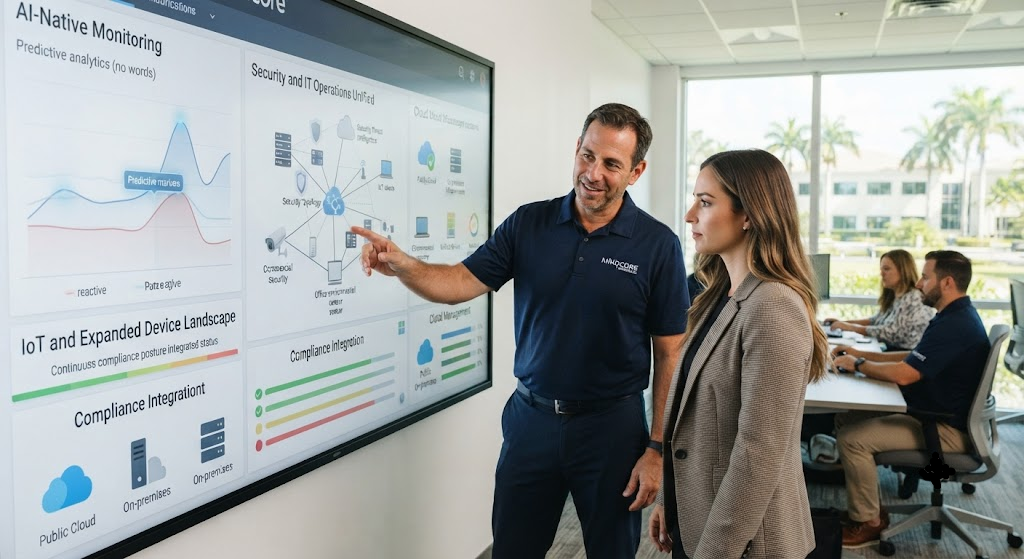
AI-powered monitoring tools now deployed by leading managed IT providers process infrastructure telemetry continuously against machine learning models that identify the patterns preceding failure events, not just the events themselves. A storage array whose read latency trend is accelerating toward a performance impact receives a proactive intervention weeks before the impact materializes. A network device whose error rate pattern matches historical failure precursors becomes a maintenance item rather than an emergency. For Boca Raton businesses in financial services and healthcare where system availability has direct client service and compliance implications, this shift from reactive to predictive operations has measurable business value.
Security Has Become Inseparable From IT Operations
In 2021, many managed IT providers and their clients treated cybersecurity as a separate service category, often delivered by a separate vendor. Managed IT handled infrastructure and support. Security handled threat monitoring and incident response. The two operated in parallel with varying degrees of integration.
The threat landscape has made that separation untenable. The attack patterns most actively targeting Boca Raton businesses in 2026, including AI-generated phishing, business email compromise, ransomware delivered through email, and supply chain attacks exploiting trusted vendor connections, require security monitoring and operational IT monitoring to be integrated at the data level rather than coordinated between separate teams after the fact.
The managed IT providers delivering the strongest security outcomes in 2026 have unified their operational monitoring and security monitoring into a single observability layer where IT performance data and security event data are correlated in real time. An anomalous login pattern that correlates with unusual network traffic and an atypical process execution on the affected endpoint is a security incident. Detecting it requires seeing all three signals simultaneously, which is only possible when operational and security monitoring are integrated rather than separated.
For Boca Raton’s wealth management, healthcare, and professional services firms, this integration also simplifies the compliance evidence requirements that regulatory frameworks create. A unified monitoring and logging architecture produces the audit trail that SEC examinations, HIPAA audits, and FINRA reviews evaluate, without requiring separate documentation processes for the security and operational dimensions of the compliance record.
IoT and the Expanded Device Landscape
The IoT device proliferation of the past five years has dramatically expanded what managed IT must cover for Boca Raton businesses across multiple sectors. The building automation systems, medical devices, security cameras, access control infrastructure, HVAC monitoring, and connected facilities equipment that now exist in commercial properties, medical offices, and financial services facilities have created an entirely new category of endpoint that traditional managed IT did not need to address.
Each of these connected devices is a potential entry point into the broader business network if it is not managed, patched, and monitored with the same discipline applied to conventional IT endpoints. The Boca Raton healthcare practices and commercial property operators that have added significant IoT infrastructure to their environments over the past five years have created attack surfaces that were not in scope for the managed IT agreements written before that infrastructure was deployed.
Managed IT providers serving Boca Raton businesses in 2026 need to have both the tooling and the operational processes to include IoT and connected infrastructure in the scope of their monitoring and management. The providers who have built this capability are providing genuinely comprehensive coverage of the current device landscape. Those who have not are providing coverage of a subset of the attack surface their clients are defending.
Compliance Integration as a Standard Service Component
Five years ago, compliance support was frequently a premium add-on to managed IT services, delivered by specialized compliance consultants whose work ran parallel to the operational IT program. For most Boca Raton businesses, the compliance documentation, control evidence, and regulatory reporting required by applicable frameworks was assembled manually by compliance staff drawing from IT systems that were not designed to produce that output efficiently.
The managed IT programs that leading providers deliver in 2026 have compliance integration built into the operational architecture rather than layered on afterward. The logging configurations, access control documentation, change management records, and security monitoring outputs that regulatory frameworks require are produced as a byproduct of normal operational management rather than through separate documentation processes.
For Boca Raton financial services firms subject to SEC cybersecurity examination, the evidence that demonstrates security program maturity, including access control records, monitoring logs, incident response documentation, and vendor risk management records, is continuously maintained within the managed IT operational platform. For healthcare organizations subject to HIPAA, the audit controls, access logs, and risk assessment documentation that OCR examinations evaluate are current and organized rather than assembled under deadline pressure when an examination is announced.
This compliance integration is not only more efficient than the parallel approach it replaces. It also produces better compliance outcomes because the documentation accurately reflects what is actually happening in the operational environment rather than being reconstructed from memory after the fact.
The Cloud Management Dimension That Has Become Central
In 2021, most Boca Raton businesses had on-premises infrastructure as their primary IT environment, with cloud services playing a supporting role. The managed IT scope reflected that reality, focused primarily on the physical and virtual infrastructure in the client’s facilities.
The ratio has inverted for most businesses. The primary workloads for most Boca Raton businesses now run in Microsoft 365, Azure, AWS, or combinations of cloud platforms, with on-premises infrastructure playing a supporting role for workloads that cannot move to cloud or where regulatory requirements create specific on-premises constraints.
Managing a cloud-primary environment requires capabilities that on-premises-focused managed IT did not need: cloud cost governance that prevents subscription and resource sprawl from inflating costs beyond projections, cloud security posture management that continuously evaluates cloud configurations against security and compliance baselines, identity and access management across cloud and on-premises resources through unified identity platforms, and the integration architecture that connects cloud services to each other and to the remaining on-premises components without creating performance bottlenecks or security gaps.
Managed IT providers serving Boca Raton businesses in 2026 who have not built genuine cloud management depth are managing an increasingly small portion of the environments their clients actually operate.
How Mindcore Technologies Delivers Modern Managed IT in Boca Raton
Mindcore Technologies has continuously evolved its managed IT service delivery over more than 30 years to reflect the changing technology and threat landscape that Boca Raton businesses navigate. Under the leadership of Matt Rosenthal, CEO of Mindcore Technologies, the company delivers managed IT services in Boca Raton that integrate AI-powered monitoring, security operations, IoT device management, compliance integration, and cloud management into a unified operational program rather than a collection of separately managed service components.
Mindcore’s approach reflects the recognition that the managed IT category has fundamentally changed and that the businesses they serve need a service that matches the current complexity of their environments, not the complexity of environments that existed five years ago.
Conclusion
Managed IT services in 2026 is a fundamentally different category from what it was five years ago, and Boca Raton businesses that are evaluating their current IT relationships against the standard of 2021-era services are holding their technology operations to an outdated benchmark. The integration of AI-native monitoring, unified security and IT operations, IoT management, compliance integration, and cloud management has redefined what the best providers are delivering and what businesses should expect from the investment.
With Mindcore Technologies and more than 30 years of continuously evolving managed IT expertise in the South Florida market, Boca Raton businesses have access to the current generation of managed IT services rather than an earlier one adapted to a technology landscape that no longer exists.
About the Author
Matt Rosenthal is the CEO and President of Mindcore Technologies, a full-service IT consulting and cybersecurity firm serving businesses across Florida, New Jersey, Maryland, South Carolina, Louisiana, Texas, and nationwide.
With more than 30 years of experience in IT operations, managed services, cybersecurity, and enterprise technology strategy, Matt has helped organizations across financial services, healthcare, fintech, and professional services build IT programs that match the operational demands of their current environments. He holds an MBA in Technology Management, is a certified Project Management Professional (PMP), and is the host of Digging In, a weekly podcast on success in business, life, and health.