

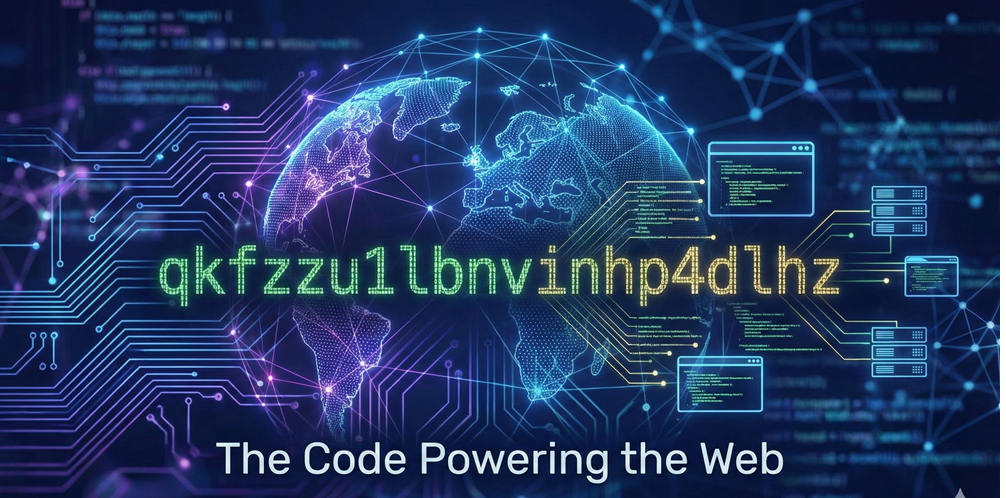
In the vast, interconnected world of the internet, it’s easy to imagine a single, master “code” that runs everything—a secret skeleton key like qkfzzu1lbnvinhp4dlhz unlocking the digital universe. While the string you’ve encountered looks techy and mysterious, the reality of what powers the web is both more complex and far more fascinating.
Behind the Screen: Demystifying the “Code” That Truly Powers the Web
The truth is, there is no single “magic string” that runs the internet. Instead, the web is built on a foundation of open, standardized technologies working in perfect harmony. Let’s explore what that random-looking string likely is, and then meet the real heroes powering every web page you visit.
What is “qkfzzu1lbnvinhp4dlhz”?
If you stumble across a long, seemingly random string of alphanumeric characters like qkfzzu1lbnvinhp4dlhz in a web page’s source code, URL, or a cookie, it’s almost certainly not a programming language or a fundamental protocol.
Instead, it is most likely a unique identifier used for a specific, temporary purpose. In web development, these strings are ubiquitous and serve several key functions:
-
Session IDs: When you log into a website, the server needs a way to remember who you are as you click from page to page. It generates a unique, random string (like a temporary ID card) and sends it to your browser as a cookie. Your browser sends this string back with every request, telling the server, “It’s still me.”
-
Tracking & Analytics Tokens: Analyitcs tools use unique identifiers to track user behavior across a site anonymously. This helps site owners understand how visitors interact with their content.
-
Security Tokens: To prevent malicious attacks like Cross-Site Request Forgery (CSRF), websites generate secret, unique tokens for each user session. These tokens ensure that a request to perform an action (like submitting a form) is legitimate and originated from the user, not an attacker.
-
Cache Busting: Sometimes developers append a random string to filenames (e.g.,
style.css?v=qkfzzu...) to force the browser to download a new version of a file instead of using an old, cached copy.
Think of these strings not as the engine of a car, but as a temporary license plate or a ticket stub. They are crucial for specific transactions but are not the machinery itself.
The Real Heroes: The Core Technologies of the Web
So, if qkfzzu1lbnvinhp4dlhz isn’t running the show, what is? Every website you visit is composed of three fundamental front-end technologies, often called the “three pillars of the web.”
-
HTML (HyperText Markup Language): The Skeleton
HTML is the foundation. It is not a programming language but a markup language used to structure content. It tells the browser, “This is a heading,” “This is a paragraph,” and “This is an image.” Without HTML, a webpage would be a shapeless blob of unformatted text. It provides the essential structure and meaning to the content.
-
CSS (Cascading Style Sheets): The Skin and Style
If HTML is the skeleton, CSS is the skin, clothing, and makeup. It is the design language that tells the browser how to present the HTML elements. CSS handles everything related to appearance: colors, fonts, layouts, spacing, and responsiveness (making a site look good on both a phone and a desktop). It turns a boring structured document into a visually appealing experience.
-
JavaScript (JS): The Muscle and Brain
JavaScript is a full-fledged programming language that brings a webpage to life. It’s responsible for interactivity and dynamic behavior. When you click a button and a menu slides out, drag an item on a map, or get live search suggestions as you type, that’s JavaScript at work. It runs directly in your browser, manipulating the HTML and CSS on the fly to create a rich, application-like experience.
Beyond the Browser: The Back-End
While HTML, CSS, and JavaScript handle everything you see and interact with in your browser (the “front-end”), an entirely different set of technologies operates on the server (the “back-end”).
When you request a page, a powerful computer somewhere in the world processes that request. Behind the scenes, languages like Python, Java, PHP, Ruby, or server-side JavaScript (Node.js) communicate with databases to retrieve information (like your user profile or a product catalog). They then assemble the final HTML page to send back to your browser. This entire process happens in milliseconds.
Conclusion
While a cryptic string like qkfzzu1lbnvinhp4dlhz might seem important, it’s just one tiny, transient piece of data in a massive system. The true “code powering the web” isn’t a secret password; it’s an open ecosystem of languages like HTML, CSS, and JavaScript, built by thousands of developers over decades. It is their combined power that creates the dynamic, interconnected digital world we use every day.