

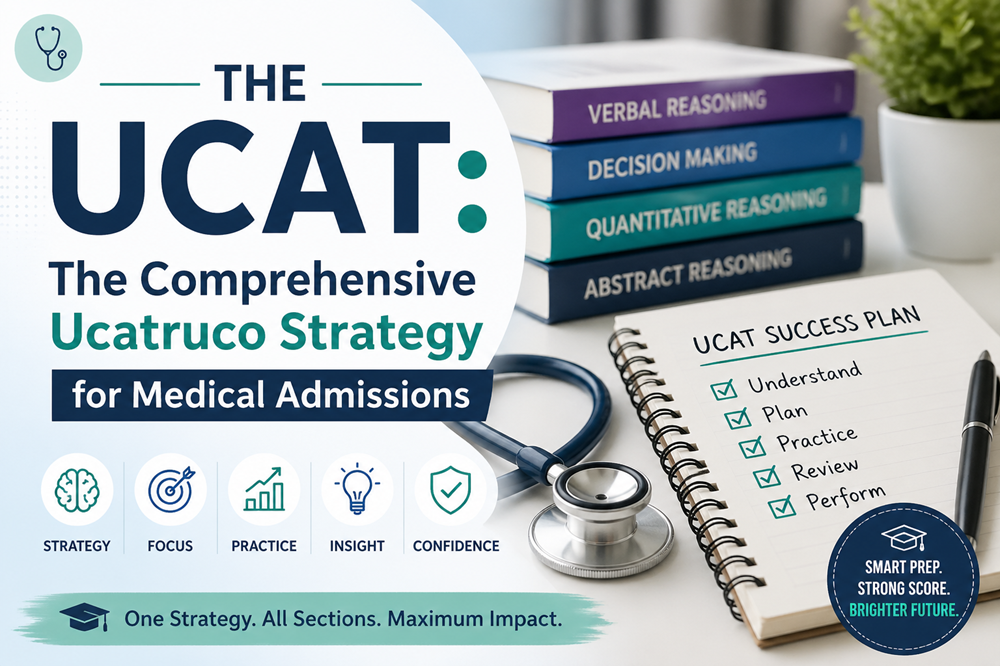
Introduction to the Ucatruco Philosophy
The path to a career in medicine or dentistry is fraught with numerous academic hurdles, but few are as formidable as the admissions test. At the heart of this journey is the University Clinical Aptitude Test (UCAT), a rigorous two-hour computer-based exam designed to assess a candidate’s cognitive abilities and professional demeanor. Over the years, the evolution of the UCAT has shifted its weight in the admissions process, making it an undeniable gatekeeper for top-tier universities.
To conquer this exam, candidates require more than just rote memorization; they need a sophisticated, tactical approach. Enter the Ucatruco philosophy—a strategic methodology dedicated to high-stakes clinical testing. Defining the Ucatruco approach means shifting the focus from simply answering questions to mastering the underlying logic of the exam.
Deconstructing the Five Pillars of the UCAT
To master the exam, one must first deconstruct it. The UCAT is divided into five distinct subtests, each designed to evaluate a specific cognitive skill set. Understanding the nuances of these five pillars is the foundation of the Ucatruco strategy.
Verbal Reasoning: Navigating Complex Texts
The Verbal Reasoning (VR) section assesses your ability to critically evaluate dense, unfamiliar written information. Candidates face long passages and must quickly decide if conclusions are true, false, or if there is simply not enough information (can’t tell). The Ucatruco method emphasizes active reading—scanning for keywords while carefully avoiding inference traps. You must answer strictly based on the text provided, stripping away any prior knowledge.
Decision Making: Mastering Logical Syllogisms
Decision Making (DM) evaluates your capacity to apply logic to reach informed conclusions. This section features complex logical syllogisms, Venn diagrams, and probability data. The key to mastering DM is understanding the strict rules of formal logic. Candidates must learn to swiftly evaluate arguments objectively, recognizing when an argument effectively addresses the core of a question versus when it relies on emotional appeal or irrelevant data.
Quantitative Reasoning: High-Speed Mental Arithmetic
In the Quantitative Reasoning (QR) subtest, candidates are bombarded with data sets, tables, and graphs. Unlike traditional math exams, QR is an exercise in high-speed data interpretation and triage. Success here relies on sharp mental arithmetic, mastering percentage changes, and knowing exactly when to use the onscreen calculator. Speed and precision are paramount.
Abstract Reasoning: Rapid Pattern Recognition
Abstract Reasoning (AR) is arguably the most visually jarring section. Candidates must identify spatial relationships and hidden rules among a series of shapes. The Ucatruco strategy employs mnemonic frameworks—such as checking for Shape, Color, Arrangement, Number, and Size—to facilitate rapid pattern recognition. The goal is to quickly categorize patterns without getting stuck on complex outliers.
Situational Judgement: Aligning with Professional Ethics
The Situational Judgement section stands apart from the cognitive subtests. It evaluates your capacity to understand real-world medical, academic, and professional scenarios. Aligning your personal responses with established medical ethics—such as patient autonomy, confidentiality, and beneficence—is crucial. Understanding the subtle difference between an action being “very appropriate” versus “appropriate, but not ideal” will dictate your success.
The Psychology of Competitive Testing
Preparing for the UCAT is as much a psychological challenge as it is an academic one. The intense, two-hour computer-based format places an enormous cognitive load on the test-taker, forcing the brain to process complex information rapidly while tracking a ticking clock.
Managing Cognitive Load
Managing cognitive load requires systematic desensitization. If you attempt to solve every question perfectly, you will run out of time and mental energy. The Ucatruco strategy advocates for mental compartmentalization—leaving the stress of a difficult Verbal Reasoning passage behind the moment you transition to Decision Making.
Stress Inoculation and Stamina
Building mental stamina to survive 233 rapid-fire questions requires stress inoculation techniques specifically tailored for the testing center environment. This means practicing with the exact screen resolution, utilizing a clunky keyboard, and wearing noise-canceling headphones to simulate the sterile, high-pressure atmosphere of a Pearson VUE testing center.
The Role of the Growth Mindset
The Ucatruco Methodology: A Step-by-Step Guide
The core of the Ucatruco philosophy is a highly structured, five-step study methodology. Skipping directly to full mock exams is a recipe for burnout; instead, candidates must build their skills from the ground up.
Step 1: The Baseline Diagnostic
Before undertaking any serious study, you must establish a baseline. Take a full, timed diagnostic exam without any prior preparation. The goal here is not a high score, but radical self-awareness. Identifying your natural strengths and fatal flaws early allows you to allocate your study time proportionally. If you score well in Quantitative Reasoning but poorly in Verbal Reasoning, your study schedule must reflect that discrepancy.
Step 2: Untimed Skill Acquisition
Once your baseline is established, remove the clock. Focus on untimed skill acquisition. In this phase, your sole objective is to master the logic behind every question category. Read the explanations for every single practice question, even the ones you get right. Understand *why* the correct answer is correct and *why* the distractors are wrong. This deep, analytical learning is where actual cognitive development occurs.
Step 3: The Timed Transition
As your accuracy reaches a consistent 80 to 90 percent in untimed conditions, begin the timed transition. Start by setting generous time limits, and gradually restrict them over a period of weeks until you are matching the official UCAT pacing (e.g., 14 seconds per Abstract Reasoning question). This phased transition builds speed without sacrificing the accuracy you developed in Step 2.
Step 4: Full-Length Simulation
Approximately four weeks before your exam, shift your focus to full-length simulations. Replicating official test conditions with high-fidelity mock exams builds endurance. Sit at a desk, clear away your phone, use a wired mouse, and do not pause the test. Enduring the full two hours without interruption trains your brain to maintain focus even when fatigue sets in.
Step 5: Iterative Performance Analysis
Taking the mock exam is only half the work; the real progress happens in the review. Implement an iterative performance analysis using a detailed error log. Document every incorrect answer, categorize the error type (e.g., “misread the data,” “calculation error,” “ran out of time”), and write down a specific, actionable step to prevent it in the future.
Advanced Time Management and Technical Mastery
In the UCAT, time is your ultimate adversary. Because all cognitive subtest questions carry equal weight, spending three minutes on a complex algebra problem is a tactical disaster if it costs you the opportunity to answer five simple data interpretation questions.
The Flag and Move System
Mastering the Flag and Move system is non-negotiable. Strategic guessing is a core pillar of the Ucatruco method. If you identify a question that will take longer than your allotted average time, you must flag it, guess an answer, and move on immediately. You can always return to it if time permits at the end of the section, but maximizing your raw score means harvesting all the “easy” marks first.
Keyboard Shortcut Mastery
Technical mastery of the interface can save you minutes over the course of the exam. Keyboard shortcut mastery is essential. Learn to navigate using the `Alt + N` (Next), `Alt + P` (Previous), and `Alt + F` (Flag) commands. Never use the mouse to click these buttons.
Triage and the Onscreen Calculator
Resource Selection and Study Planning
The effectiveness of your preparation is heavily reliant on the quality of the resources you choose. The market is saturated with preparation materials, but selecting Ucatruco-aligned platforms is key.
Evaluating Question Banks
Evaluate question banks based on their fidelity to the real exam. The best prep platforms offer thousands of questions that accurately reflect the difficulty and interface of the actual UCAT. Look for platforms that provide detailed statistics, allowing you to track your speed and accuracy across different sub-topics.
Designing a Study Schedule
Designing a 6-to-12 week study schedule is the sweet spot for most candidates. Anything shorter leads to panic; anything longer often results in academic burnout and skill decay. Structure your schedule to include dedicated days for specific subtests, mixed practice days, and mandatory rest days to allow your brain to recover.
Peer Study vs. Independent Practice
While independent, rigorous practice is necessary for building speed and focus, peer study groups offer unique benefits. Explaining logical puzzles to a peer can solidify your own understanding, and studying with others can help maintain motivation during the grueling preparation period.
Official Consortium Materials
Finally, as your test date approaches, integrate official UCAT consortium materials into your final revision phase. The official mock exams provided by the test makers are the absolute closest representation of the actual scoring algorithm and question styling. Save these for the final two weeks of your preparation.
Common Pitfalls and How to Avoid Them
Even with a strong strategy, many capable students fall into predictable traps that sabotage their scores. Recognizing these pitfalls early is essential for Ucatruco mastery.
The Danger of Passive Learning
The most common mistake is the danger of passive learning. Over-reliance on reading theory books or watching instructional videos without engaging in active problem-solving provides a false sense of security. The UCAT is a skills-based test, not a knowledge-based one. You must practice actively.
Underestimating the Situational Judgement Test
Another frequent error is underestimating the Situational Judgement Test (SJT). Because it does not contribute to the main three-digit cognitive score, candidates often neglect it. However, many top universities use the SJT banding as a strict cutoff or as a deciding factor between equally matched candidates. A Band 4 in SJT can lead to automatic rejection at several prestigious institutions.
Ignoring Digital Interface Constraints
Failing to practice with the specific constraints of the onscreen digital interface is a crucial oversight. Practicing on an iPad or a small laptop screen does not replicate the desktop environment of the test center. You must accustom yourself to a standard mouse, a physical whiteboard, and a non-touchscreen interface.
Neglecting Physical Well-being
Lastly, never neglect your physical well-being. There is a direct, scientifically proven correlation between sleep, nutrition, physical exercise, and cognitive test performance. Cramming late into the night diminishes your executive functioning and working memory—the exact faculties required to excel on the UCAT.
Conclusion: From Preparation to Professionalism
The Ucatruco methodology is more than just a test-prep strategy; it is an initiation into the rigors of medical and dental training. By mastering the intricate balance of time management, logical reasoning, and stress control, you are building a cognitive foundation that will serve you well beyond admission.
Long-Term Benefits
The long-term benefits of the Ucatruco methodology extend far into the future. The ability to triage critical information under pressure, recognize ethical boundaries in complex scenarios, and maintain emotional resilience in the face of fatigue are precisely the skills that translate to success in medical school, clinical rotations, and eventual practice as a healthcare professional.
The Final 24-Hour Checklist
As the exam approaches, preparation must transition into preservation. In the 24 hours leading up to the examination, close your books. Implement this final checklist:
- Cease all practice: Prevent last-minute panic by trusting the preparation you have completed.
- Review logistics: Confirm your test center location, travel route, and ensure your approved photo identification is packed.
- Rest and Hydrate: Prioritize a full eight hours of sleep and eat a balanced, familiar meal.
- Prepare your mindset: Walk into the testing center with confidence, remembering that strategic execution, not perfection, is the goal.
Mastering the UCAT is undeniably demanding, but with the comprehensive Ucatruco strategy, a high score is not left to chance—it is systematically achieved. Embrace the process, trust the methodology, and take your first confident step toward a rewarding career in medicine.“`