

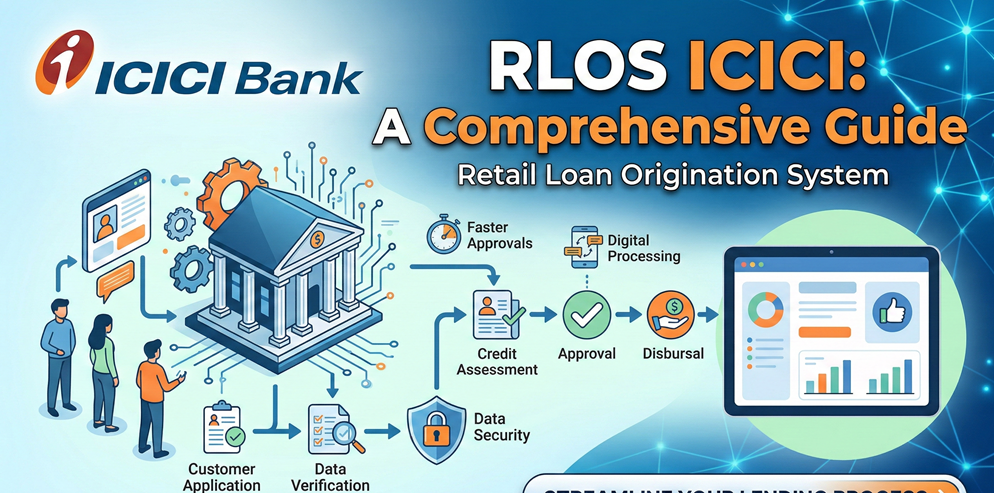
In the rapidly evolving landscape of Indian banking, digital transformation is no longer a luxury but a necessity. At the forefront of this shift is ICICI Bank, which has leveraged technology to redefine how credit is delivered to millions. Central to this transformation is the RLOS ICICI (Retail Loan Origination System), a sophisticated software architecture designed to automate and streamline the end-to-end journey of retail loan products.
For banking professionals, fintech developers, and IT consultants, understanding the ICICI Bank Retail Loan Origination System is essential for grasping how modern “instant” lending works. This guide provides a deep dive into the features, workflow, and benefits of the RLOS platform.
Key Takeaways
- RLOS stands for Retail Loan Origination System, the backbone of ICICI’s digital lending.
- It automates everything from lead generation to final disbursement.
- The system significantly reduces Turnaround Time (TAT) through real-time credit checks and OCR technology.
- While it powers customer-facing apps like iMobile, RLOS itself is an internal-facing system for bank employees and partners.
What is RLOS in ICICI Bank?
Definition and Core Purpose
The Retail Loan Origination System (RLOS) is a comprehensive software platform used by ICICI Bank to manage the lifecycle of a loan application. From the moment a customer expresses interest in a loan to the final credit being deposited into their account, RLOS acts as the central engine. It handles data entry, document verification, credit scoring, and legal compliance.
By integrating various modules into a single interface, RLOS ensures that the bank can process high volumes of retail loans—such as personal loans, home loans, and car loans—with minimal manual intervention.
The Shift from Manual to Digital Lending
Before the implementation of the ICICI digital lending platform, loan processing was a paper-intensive, multi-day affair. Customers had to submit physical copies of KYC documents, income proofs, and bank statements, which were then manually verified by credit officers.
The introduction of RLOS ICICI marked a paradigm shift. By digitizing the workflow, the bank transitioned from “document-centric” processing to “data-centric” processing. This shift has allowed ICICI Bank to offer “Pre-approved” and “Instant” loan products, where the time from sanction application is measured in minutes rather than weeks.
Key Features of the ICICI RLOS Platform
The ICICI loan processing software is built on a modular architecture, allowing it to communicate with various external and internal databases. Here are its core features:
Automated Data Capture & OCR
One of the most powerful features of RLOS is its Optical Character Recognition (OCR) capability. When a sourcing agent scans a customer’s Aadhaar card, PAN card, or salary slip, the system automatically extracts the relevant data. This eliminates manual data entry errors and speeds up the “onboarding” phase.
Integration with Credit Bureaus (CIBIL, Experian)
RLOS is via API to major credit bureaus. As soon as a lead is generated, the system triggers a real-time inquiry to fetch the applicant’s credit score and history. This enables the ICICI Bank Retail Loan Origination System to provide instant eligibility feedback to the customer.
Real-time Rule Engines and Scorecards
The heart of RLOS is its Business Rule Engine (BRE). ICICI Bank’s credit policies are programmed directly into the system. The software evaluates the applicant’s income, existing debts, and credit history against these rules. If the applicant meets the criteria, the system can “auto-approve” the loan without a human credit manager ever seeing the file.
Document Management System (DMS) Integration
Digital lending requires a robust way to store and retrieve documents. RLOS is integrated with a centralized Document Management System (DMS). Every scanned document is tagged with a unique lead ID, ensuring a paperless audit trail and easy retrieval for compliance checks.
The Step-by-Step Loan Processing Workflow in RLOS
To understand the ICICI Bank loan automation process, one must look at the path a loan application takes through the RLOS ecosystem.
1. Lead Generation and Data Entry
A loan lead can originate from various sources: the iMobile app, the ICICI website, a branch visit, or an authorized third-party agent. The agent or customer enters basic details into the system. At this stage, the RLOS ICICI system performs a “dedupe” check to see if the customer already has an existing relationship with the bank.
2. Credit Underwriting and Verification
Once the data is captured, the system performs automated verification. This includes:
- E-KYC: Verifying identity through Aadhaar/biometrics.
- Bureau Check: Pulling CIBIL/Experian reports.
- Fraud Check: Cross-referencing data against internal negative lists.
3. Sanctioning and Documentation
If the BRE gives a “Green” signal, the loan is sanctioned. An e-sanction letter is generated. The customer can then perform an e-Sign on the loan agreement, making the process entirely digital. For more complex loans like Home Loans, the system triggers parallel workflows for legal and technical valuation of the property.
4. Final Disbursement
The final stage is the transfer of funds. RLOS communicates with the bank’s Core Banking System (CBS) to create the loan account and trigger the NEFT/RTGS transfer to the customer’s or builder’s account.
Benefits of RLOS for ICICI Bank and Its Customers
The implementation of a Retail Loan Origination System offers a win-win scenario for both the institution and the consumer.
Reduced Turnaround Time (TAT)
The primary metric of success for RLOS is the reduction in TAT. By automating credit checks and eliminating the physical movement of files between departments, ICICI Bank has reduced the processing time for personal loans from 5–7 days to under 30 minutes in many cases.
Enhanced Operational Efficiency
Automation allows the bank to handle a much higher volume of applications without a proportional increase in headcount. Employees are freed from repetitive data entry tasks and can focus on complex credit assessments that require human judgment.
Improved Risk Management and Compliance
Because the rules are hardcoded into the RLOS ICICI system, there is less room for “judgment errors” or policy deviations. Every action taken in the system is logged, providing a perfect audit trail for the Reserve Bank of India (RBI) and internal auditors.
RLOS ICICI Login and Internal Access
It is important to clarify that ICICI RLOS login portals are not intended for general bank customers.
- Who uses it? Bank employees (Sales Officers, Credit Managers), authorized sourcing agents, and backend operations teams.
- Security Protocols: Access to RLOS is strictly controlled. It usually requires a secure VPN, Multi-Factor Authentication (MFA), and Single Sign-On (SSO) credentials linked to the employee’s internal ID.
- Role-Based Access: A Sales Officer can only enter data, while a Credit Manager has the authority to “Approve” or “Reject.” This segregation of duties is a critical security feature of the ICICI loan processing software.
The Future of Digital Lending at ICICI Bank: AI and ML Integration
ICICI Bank is already looking beyond basic automation. The next evolution of RLOS ICICI involves the integration of Artificial Intelligence (AI) and Machine Learning (ML).
- Predictive Analytics: Using ML to predict the likelihood of default based on non-traditional data (e.g., spending patterns) rather than just credit scores.
- Hyper-Personalization: RLOS will eventually be able to offer custom interest rates and loan amounts tailored to the specific risk profile and needs of an individual in real-time.
- Voice-Bot Integration: Imagine starting a loan application via a voice assistant, where the RLOS backend processes the conversation to fill out the application form.
Frequently Asked Questions (FAQs)
1. What does RLOS stand for?
RLOS stands for Retail Loan Origination System. It is the software used to manage and automate the retail lending process.
2. Is RLOS the same as the iMobile app?
No. iMobile is the customer-facing interface. RLOS is the backend “engine” that processes the information submitted via iMobile.
3. Which loan products are handled by RLOS ICICI?
It handles a wide variety of retail products, including Personal Loans, Home Loans, Car Loans, Two-Wheeler Loans, and Business Loans for SMEs.
4. How does RLOS improve the customer experience?
By providing faster approvals, requiring fewer physical documents, and allowing customers to track their loan status in real-time.
5. Can I access the ICICI RLOS login from home?
Only authorized ICICI Bank employees and partners can access the RLOS login, typically via a secure bank-provided device or a secure VPN connection.
Conclusion
The RLOS ICICI system is a testament to how traditional banking can successfully pivot into the digital age. By combining automated data capture, real-time credit checks, and robust rule engines, ICICI Bank has created a lending ecosystem that is fast, secure, and highly efficient.
As the fintech landscape continues to evolve, the Retail Loan Origination System will remain the cornerstone of ICICI’s strategy to deliver credit to the “Next Billion” users in India. For professionals in the sector, RLOS represents the gold standard of how technology can be harnessed to bridge the gap between financial institutions and consumer needs.