

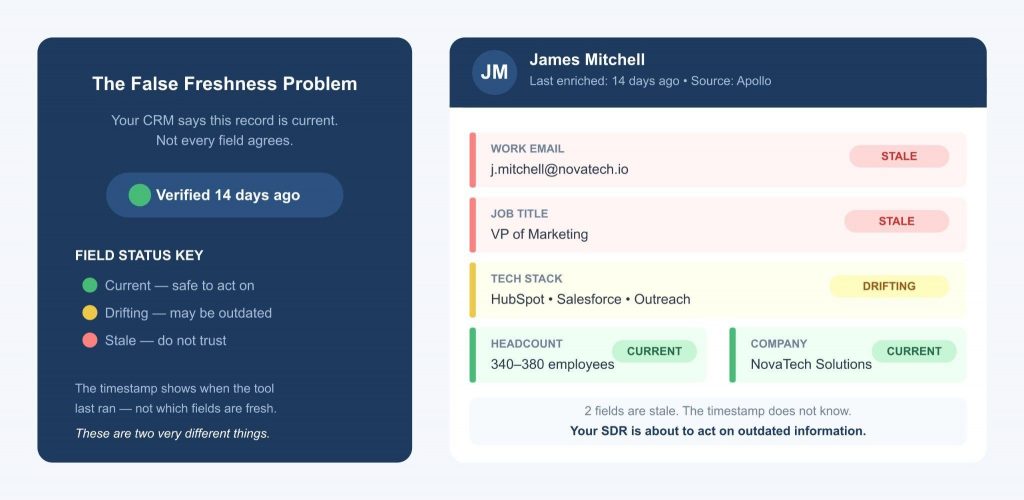
A “recently updated” data field record can create false confidence, especially for teams relying on B2B data enrichment tools for data freshness.
Sales and marketing teams often trust timestamps such as “verified X days ago” or “last enriched this month” attached to the data they get from enrichment tools. On the surface, those signals suggest the record is current. In practice, they only confirm that a system ran an update. They do not confirm whether the fields most critical to your campaign are still accurate.
If you want to stop wasting sales cycles on bad data, you need to shift from calendar-based CRM data enrichment to a value-based one. That starts with seeing how differently each field ages — contact data, job titles, tech stack, and firmographics — and then grading your data on three fronts: how fast it spoils, how much it impacts your messaging, and how close that account is to a live deal. Let’s explore that!
Why a Uniform CRM Refresh Cycle Creates Data Quality Issues?
| “Most companies still treat their CRM as a static data-collection exercise rather than the revenue intelligence system it’s meant to be.”
Pavan Kakar, VP(AI Data & B2B Intelligence), SunTec India | CRM Data Enrichment for Better Audience Targeting & Lead Generation |
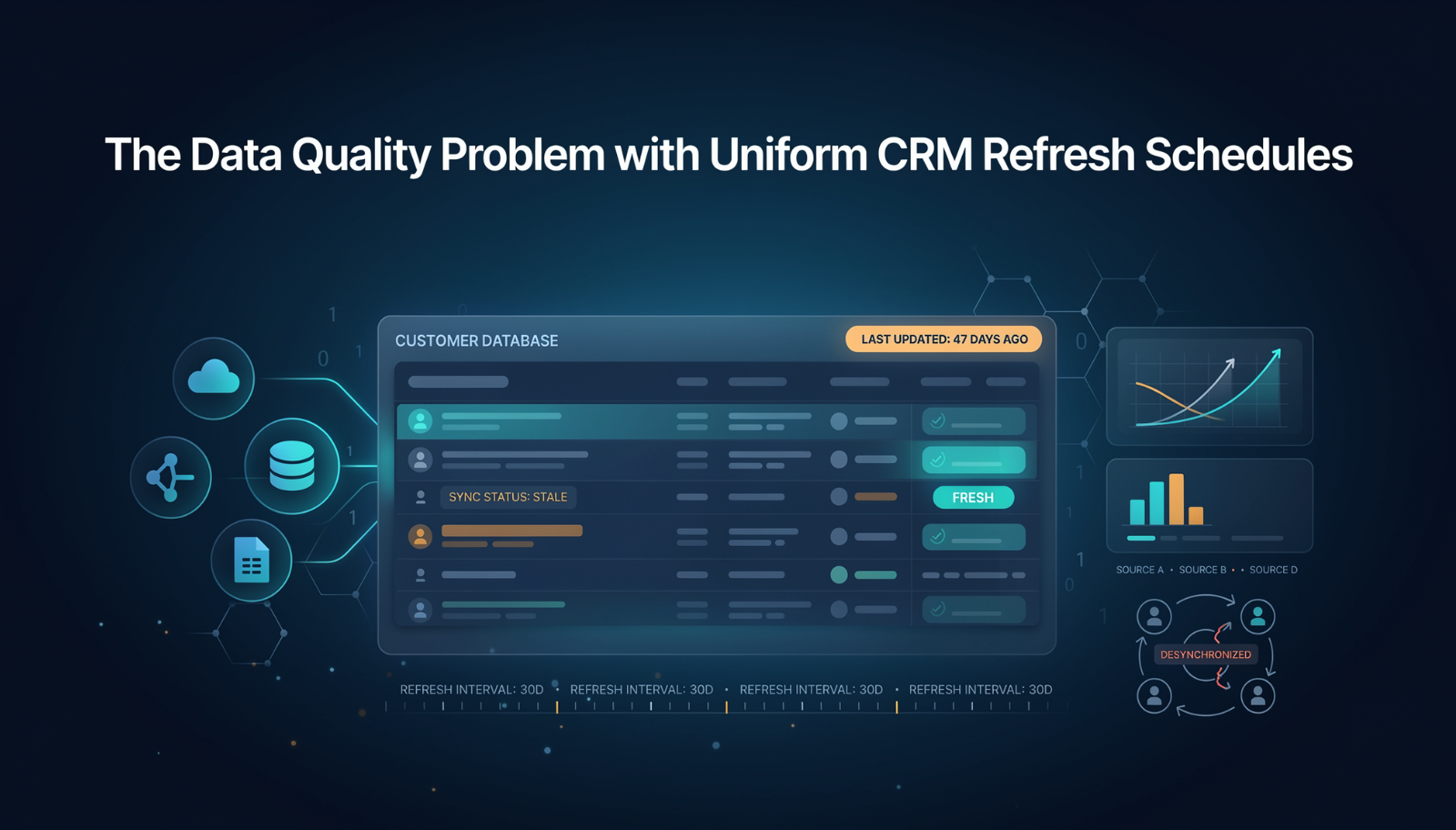
Most B2B data enrichment tools operate on a fixed schedule. 30 days is the most common default. Some data enrichment vendors run at 60 or 90. That architecture makes operational sense from a vendor perspective — predictable, billable, scalable. But for teams relying on CRM data enrichment to guide outreach, segmentation, and pipeline decisions, it is almost entirely disconnected from how individual data fields actually age.
A contact record may contain:
- Email address
- Phone number
- Job title
- Seniority level
- Company size
- Location
- Funding status
- Technology stack
- Industry
- Buying committee role
Email addresses do not decay on a monthly schedule. They are stable for years, then suddenly become invalid the moment someone changes jobs or the company domain changes. Job titles in tech companies change faster than titles in financial services, which change faster than titles in the public sector. Tech stacks shift continuously — a company’s tool suite looks meaningfully different from one quarter to the next. Headcount moves in response to funding events, which arrive unpredictably. Funding data is event-driven: when a company raises a Series B, every assumption your outreach was built on — ICP (Ideal Customer Profile) fit, deal size, stakeholder map, urgency — shifts.
Simply put, contact data enrichment behaves differently from company data enrichment. Job title enrichment behaves differently from technology stack enrichment. Refreshing them all at the same interval means you are either spending credits on data that hasn’t changed, or missing changes that have already cost you a deal.
What Actually Matters for CRM Data Enrichment: Field-Level Data Decay
Mapping how each data type ages is what separates strategic B2B data enrichment from vendor defaults.
1. Contact Data Enrichment Needs Trigger-Based Validation
Contact data enrichment includes email, phone number, and decision-maker details. These fields matter because they affect direct outreach.
Email data is especially sensitive. A verified business email address may remain valid for a long period. But once a person leaves the company or the company changes domain, the address becomes useless immediately. And, job changes occur randomly every day. So, better triggers for contact data enrichment can be:
- Email bounce signals
- Job-change alerts
- Domain changes
- Company acquisition updates
- LinkedIn profile changes
2. Job Title Enrichment Should Vary by Industry
Job titles influence segmentation, lead routing, messaging, and account-based marketing. But title changes are not consistent across industries.
LinkedIn’s January 2025 Work Change Report found that professionals entering the workforce today are on pace to hold twice as many jobs over their careers compared with 15 years ago. That means the overall speed for data decay for the job title speed has doubled.
This also matters significantly for B2B contact enrichment because job role shifts vary by industry and niche. For instance, a revenue leader at a SaaS company may move roles faster than a compliance executive in banking. Or, a public-sector decision-maker may stay in the same role longer.
So, job title enrichment should not follow a single rule. A practical CRM data enrichment model for this field may look like this:
- Tech and SaaS titles: validate every 6 to 8 weeks
- Financial and regulated roles: validate quarterly
- Public-sector roles: validate quarterly or semiannually
- Active pipeline contacts: monitor for job-change signals
- Cold database contacts: refresh less frequently
3. Technology Stack Enrichment Needs Structured Rechecks
Tech stack data — which software a company uses, what integrations are active, what has been recently adopted or dropped — is among the fastest-moving fields in any B2B database. Technographic data enrichment is also harder to do accurately because a company’s technology stack is not static. Teams add tools, test new software, cancel licenses, and adopt applications outside central IT rules.
Okta’s Businesses at Work 2025 report, based on anonymized data from its global customer base and Okta Integration Network, found that the average U.S. organization now runs 114 applications. Zylo’s 2026 SaaS Management Index, built on more than 40 million SaaS licenses and $75 billion in spend under management, found that organizations leave an average of 36% of their SaaS licenses unused. Business units now control 81% of SaaS spend, while IT directly manages only 15%, showing how tools continue to enter organizations but remain unused.
What this tells you is that the tech stack captured by data enrichment tool vendors for your prospects at any given moment is already a partial picture. The tools a company appears to license may not reflect what teams actively use. Some applications may be underused, replaced, added through business units, or adopted outside the formal license roster that most enrichment platforms draw from. A standard 30- or 60-day refresh cycle updates only what has changed in a vendor’s database, not in the company’s actual operating environment.
For technology-led sales campaigns — teams selling into the stack, targeting based on competitive displacement, or personalizing outreach around known tools — that gap has direct consequences. For them, the right approach to technographic data enrichment involves two distinct activities.
- A full tech stack re-enrichment — cross-referencing what a company formally licenses with job postings, product review activity, and integration signals — should occur at least quarterly.
- Within that quarterly cycle, Tier 1 accounts in the active pipeline should be monitored weekly for intent signals, such as new job posts mentioning specific technical skills, integration announcements, and partner ecosystem updates.
This makes technographic enrichment more closely aligned with real buying signals.
4. Company Data Enrichment Needs Field-Based Rules
Company data includes headcount, location, industry, and revenue range, which are slow-moving baselines. But firmographic data also includes funding and ownership changes, which are binary, event-based, and highly time-sensitive. These should be treated differently.
For instance, take headcount.
According to LinkedIn’s January 2026 Workforce Report, which covers data through December 2025, US national hiring remains over 20% below pre-pandemic levels — and has slowed a further 1.1% since the start of 2025. That figure indicates: “headcount barely moves, refresh quarterly.” But that figure is an aggregate blending two different groups:
- The stable majority — mature companies whose headcount genuinely crawls. The quarterly company data enrichment schedule is correct for them.
- The volatile tail — early-stage SaaS, recently funded firms, where headcount is exploding, and where headcount is the exact primary ICP signal your sales team uses to decide who to call.
Similarly, for funding data, alerts work better than routine refreshes. Named accounts should be consistently monitored for funding rounds, acquisitions, leadership changes, and expansion announcements.
The Downstream Cost of Uniform Data Enrichment Schedules: Wasted Ad Spend and Impacted Brand Reputation
Lead without a proper B2B data enrichment strategy, and you’ll end up creating practical problems across revenue workflows. It can affect:
- Lead scoring when stale headcount changes account priority
- ABM (Account-Based Marketing), when target accounts are pitched on ideas built over outdated firmographic data
- Demand generation when segments rely on old titles
- Sales when reps contact the wrong decision-maker
The problem becomes more visible when AI enters the workflow. AI-powered outreach tools often use CRM fields to create personalized outreach messages and improve click-through rates. But a message personalized around a tech stack the company retired last quarter, or a designation the contact was promoted up from six months ago, signals to the prospect that the sender is not very genuine. It dismantles the lead generation campaign and negatively impacts your brand reputation/authority.
How to Build CRM Data Refresh Rules for Your Campaign
Start with field-level logic. Identify the fields that are closest to becoming obsolete. Then consider the impact of that lead on sales and
1. Group Fields by Their True Decay Rate
Categorize standard fields to avoid wasting expensive data credits on stable fields while neglecting hyper-volatile ones.
- High-Volatility Fields (Real-Time Triggers Required): Email validity, active funding rounds, major corporate acquisitions, and LinkedIn job changes.
- Medium-Volatility Fields (6 to 12-Week Rechecks): Technographic stacks, specific job titles, and early-stage startup headcount.
- Low-Volatility Fields (Quarterly to Semiannual Refreshes): Enterprise headcount ranges, primary office location, industry classification, and annual revenue baselines.
2. Weight Data Refresh Priority by Sales Impact
Not every field has the same business value. Identify your primary Ideal Customer Profile (ICP) hook and anchor your highest-frequency enrichment budget there:
- Persona-Led Outbound: If your messaging relies on specific buyer personas, mandate strict validation on Job Title and Seniority Level first.
- Tech-Led Outbound: If you sell a software integration, allocate your budget toward continuous Technographic Enrichment and intent signals over contact-level details.
- Account-Based Marketing (ABM): If you target high-value enterprise accounts, prioritize continuous Firmographic Monitoring (funding, executive churn) over your broader, cold database.
3. Determine CRM Data Enrichment Schedule by Pipeline Stage
Accounts that have entered a live sales cycle (hot leads) require more frequent data decay checks than accounts further up the funnel (warm/cold leads). Instead of a blanket data update policy, immediately refresh decision-makers’ contact info and job titles, and the company’s recent funding status for the former, with an “expiration date” of no more than 30 days. For the latter, you can schedule a medium to low-priority 90-180-day refresh cycle.
The Rule of Thumb: Refresh CRM Data Based on Risk, not Routine
True data quality isn’t about running more batch updates or burning through vendor credits to check boxes. It is about aligning your enrichment architecture to the real-world behavior of your data fields, the specific volatility of your target industries, and the velocity of your live pipeline. My advice is to stop treating your leads database like a static spreadsheet and start treating it like a living ecosystem.
Author Bio:

Pavan Kakar is the Associate Vice President of International Sales (Digital Division) at SunTec India and has been associated with the company for over 20 years. His core expertise lies in customer relationship management, project management, resource management, management information systems(MIS), and lead generation. In between his packed schedule, he finds time to pen down informative articles to educate readers on how they can drive business value in the constantly evolving digital landscape.