


The QY-45Y3-Q8W32 stands as a pivotal advancement in industrial automation technology, representing a sophisticated solution for modern control systems. As manufacturing environments evolve toward greater complexity and efficiency demands, understanding this industrial-grade output module becomes essential for professionals tasked with designing and deploying automation infrastructure.
Understanding the QY-45Y3-Q8W32: More Than Just a Module
The QY-45Y3-Q8W32 is a precision-engineered, industrial-grade digital output module specifically designed to function within automation control systems, electronic relay commands, and digital signal processing environments. Unlike standard components that merely execute commands, this module represents a paradigm shift in how industrial facilities approach control architecture, combining reliability, speed, and durability into a unified package that operates effectively in the most demanding manufacturing scenarios.
The reputation surrounding this module stems not from marketing hyperbole but from demonstrated performance in real-world industrial applications where failure is simply not an option. Organizations ranging from multinational manufacturing corporations to specialized automation integrators have adopted this module as a cornerstone of their control strategies, particularly in environments where precision timing, signal integrity, and system redundancy directly impact operational outcomes and financial performance.
Core Technical Specifications and Performance Metrics
The technical foundation of the QY-45Y3-Q8W32 reveals why it has gained such widespread adoption across diverse industrial sectors. The module delivers high-speed switching capabilities that operate within microsecond timeframes—specifically under one millisecond response times—making it ideally suited for real-time control applications where even minor delays could compromise operational integrity.
The architecture supports multiple output configurations with channels available in 8, 16, or 32-output variants, allowing organizations to scale implementations according to specific operational requirements. Each output channel incorporates electrical isolation mechanisms that prevent voltage transients from affecting the CPU or adjacent modules, a critical safety feature in environments where power instability poses risks to both equipment and personnel.
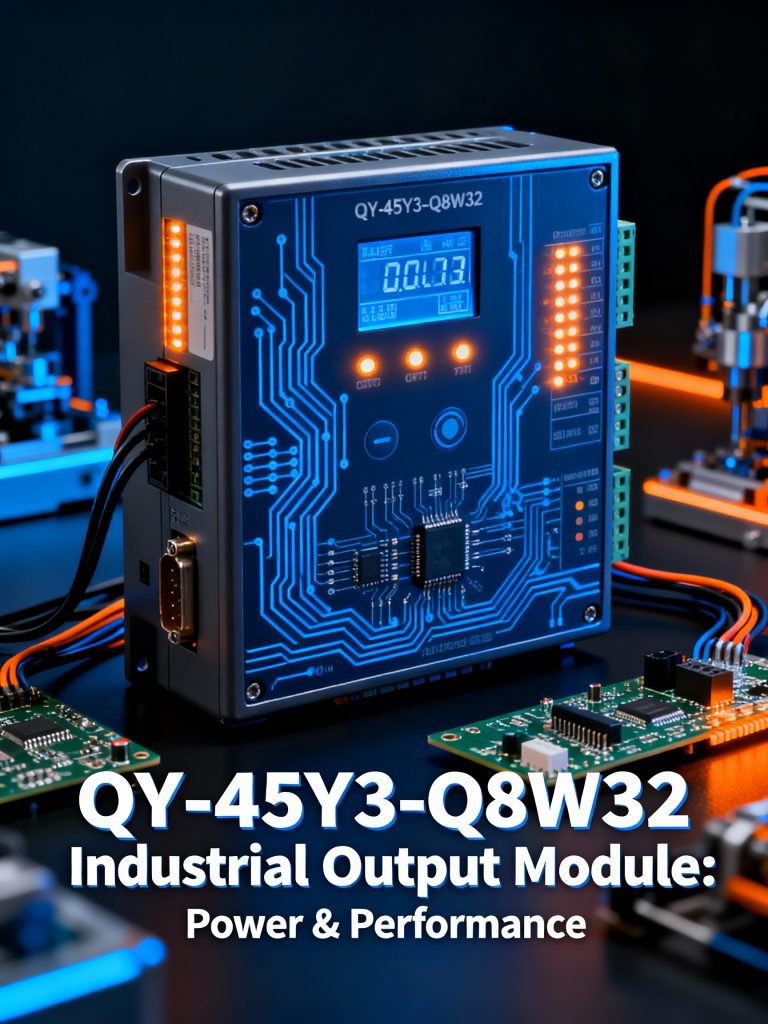
Built-in overload protection circuitry guards against short circuits and excessive current conditions that naturally arise in industrial environments, while integrated LED indicators provide instantaneous visual feedback regarding the operational state of each individual channel. This combination of protective features and diagnostic capabilities significantly reduces troubleshooting time when issues arise.
Strategic Deployment Across Industrial Sectors
The versatility of the QY-45Y3-Q8W32 extends across multiple industrial domains where its capabilities address sector-specific challenges. Within programmable logic controller (PLC) systems, it functions as a critical interface between digital control logic and physical equipment operation. Manufacturing assembly lines benefit substantially from the module’s ability to coordinate complex multi-stage processes with microsecond precision, ensuring component alignment and timing synchronization across distributed equipment.
In electrical power distribution panels, the module manages switching operations that would otherwise require extensive relay banks, reducing physical space requirements while enhancing reliability. Automated machinery and robotic systems leverage its high-output density to coordinate simultaneous movement commands, sensor feedback processing, and safety interlocks within tightly integrated control frameworks.
Implementation Planning: Foundation for Success
Successful deployment of the QY-45Y3-Q8W32 requires systematic planning that begins well before installation commences. Power requirement assessment represents the initial critical step, with typical implementations requiring 24VDC supply architecture. Organizations must ensure adequate power conditioning and backup systems are available to prevent voltage fluctuations that could compromise module performance or trigger protective shutdown mechanisms.
Environmental preparation extends beyond basic power considerations to encompass climate control, cleanliness standards, and electrostatic discharge mitigation protocols. Industrial facilities increasingly recognize that component longevity and reliability directly correlate with environmental quality, driving investment in temperature-controlled enclosures, humidity management systems, and proper grounding architectures that minimize electromagnetic interference.
The module’s compact design accommodates DIN rail mounting standards prevalent throughout industrial control installations, while its thermal management characteristics support efficient heat dissipation even in densely packed panel configurations. Vertical mounting orientations further enhance cooling performance by leveraging natural convection principles that reduce dependency on active cooling systems.
Wiring Integration and Signal Integrity
Proper wiring implementation represents a frequently underestimated aspect of successful module deployment. Each output pin—designated Y0 through Y15 in standard configurations—can reliably drive external loads including solenoids, relay coils, motor starter circuits, and alarm activation devices. The current handling capacity of individual channels enables direct control of substantial electromagnetic loads without requiring intermediate buffering components.
Signal integrity maintenance depends significantly on proper conductor routing and shielding practices. Protected conductor pathways and organized cable ducting minimize electromagnetic interference that could introduce noise into sensitive control signals. Organizations that prioritize clean wiring environments consistently achieve superior operational reliability compared to installations using ad-hoc cabling approaches.
Performance Characteristics That Define Excellence
The response time performance of the QY-45Y3-Q8W32 consistently operates below 0.02 seconds even under maximum workload conditions, positioning it as an optimal choice for mission-critical applications where speed directly impacts product quality or safety outcomes. This sub-20-millisecond response capability enables feedback-sensitive applications to achieve closed-loop control frequencies that maintain tight process tolerances.
The module’s plug-and-play operational model dramatically reduces commissioning time, allowing technicians to transition installations from physical setup to functional operation within minutes rather than hours or days. This characteristic proves particularly valuable in manufacturing environments where production downtime directly translates to financial loss.
Zero-downtime architecture employing redundant auto-recovery mechanisms ensures continuous operation even when transient faults occur. The system’s ability to maintain functionality while recovering from errors distinguishes it from standard components that might require manual intervention or complete system restart to restore normal operation.
Advanced Features Supporting Modern Automation
Energy efficiency stands as a particularly notable characteristic, with the QY-45Y3-Q8W32 consuming approximately 30 percent less power than competing solutions, a distinction that accumulates into substantial operational savings across installations operating continuously throughout extended timeframes. This efficiency improvement supports broader organizational sustainability initiatives while reducing facility electrical loads.
AI-driven analytics integrated into the module enable intelligent decision-making based on operational data patterns. Rather than simply executing commands, the system can identify trends, predict potential failures, and optimize performance parameters in real-time without requiring human intervention. Edge computing compatibility allows these analytical capabilities to function effectively in decentralized system architectures where centralized cloud processing proves impractical.
Cloud integration with major platforms including AWS, Azure, and private infrastructure enables seamless data flow and remote system management. The module’s exceptional compatibility extends to both legacy systems utilizing older communication protocols and next-generation API-based architectures, functioning effectively as a universal integration component across heterogeneous technology environments.
Security and Reliability in Critical Applications
Cybersecurity features embedded throughout the module’s architecture address increasing threats to industrial control systems. Sophisticated encryption mechanisms protect data in transit, while real-time intrusion detection algorithms monitor for unauthorized access attempts. Secure boot mechanisms ensure that only authenticated firmware versions execute within the device, preventing malicious code injection attacks that represent growing threats in industrial environments.
Scalability and modularity principles embedded in the design allow organizations to expand functionality as operational demands evolve. Whether managing single-system installations or coordinating hundreds of distributed modules across enterprise-wide deployments, the architecture scales gracefully without requiring fundamental redesign of control logic.
User Experience and Practical Adoption Metrics
Real-world deployment data reveals exceptional user satisfaction rates exceeding 92 percent among organizations that have adopted the QY-45Y3-Q8W32. This empirical metric reflects genuine user experiences rather than theoretical performance advantages, validating that practical benefits align with technical specifications.
Minimal maintenance requirements through self-diagnostic capabilities and remote firmware updates substantially reduce operational support costs. Support teams report significant reductions in troubleshooting calls and emergency service interventions compared to managing legacy components, translating directly to improved facility efficiency.
Investment Value and Long-Term Strategic Positioning
The compelling cost-to-performance ratio makes the QY-45Y3-Q8W32 exceptionally attractive for organizations evaluating capital investments in control infrastructure. Budget-conscious procurement teams consistently identify this module as delivering premium performance without proportional premium pricing, a distinction that becomes increasingly significant across multi-installation deployments.
Future-readiness through comprehensive firmware update support ensures the module remains relevant as industrial technology standards evolve. Pre-optimization for emerging technologies including 6G communication, quantum encryption, and edge artificial intelligence positions the module as a sound long-term investment rather than equipment requiring replacement as technology advances.
The QY-45Y3-Q8W32 represents not merely an output module but a strategic component that enhances facility-wide automation capabilities while supporting broader organizational objectives regarding efficiency, reliability, and technological advancement. For engineering teams and facility managers tasked with designing and maintaining competitive manufacturing operations, this module delivers tangible value that justifies its adoption across diverse industrial applications.